|
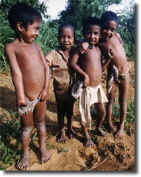 This project was started
in 1997 by WARSI that aim to protect
the remnant forest ,especially to the area where the
Orang Rimba
live in and to document the location, livelihood patterns, and
development needs of the various groups of Orang Rimba (OR) living in
Jambi Province, Sumatra. The forest
is their resource for the non-timber production such as rattan, resin,
dragon’s blood and etc. Especially the project was aimed to save the
lowland rainforest. This project was started
in 1997 by WARSI that aim to protect
the remnant forest ,especially to the area where the
Orang Rimba
live in and to document the location, livelihood patterns, and
development needs of the various groups of Orang Rimba (OR) living in
Jambi Province, Sumatra. The forest
is their resource for the non-timber production such as rattan, resin,
dragon’s blood and etc. Especially the project was aimed to save the
lowland rainforest.
There area 3000 people
of Orang Rimba (identification result 1998). Most of them stay in
hinterland area or the up stream some sub- rivers that empty to
Batanghari river. Many OR groups are now physically and economically
marginalized, living among the rubber gardens of transmigrate settlers.
Others have been able to largely maintain their livelihood
patterns within the logged and highly-threatened forests of Bukit
Duabelas (B12NP) in the center Jambi province.
Some groups have moved to the forests in the buffer zone of Bukit
Tigapuluh National Park (B30NP) in the northern part of the province.
Some live along the Sumatran High way.
Bukit Duabelas area –
since August 2000 – was declared as A National Park – is the main center of Orang
Rimba population and also a center of sub-rivers stream that empty
to Batang Hari River. The natural
forest in the area function as their life resources, same
condition with the Bukit Tigapuluh buffer zone area.
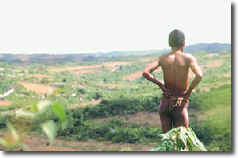 The different condition
is along Sumatran High
–way, The area is a transition zone between the lowland in the middle
of downs stream area and the hill of Bukit Barisan. The Orang Rimba live
in the inside part of inter-river area. Like most of the lowlands on the
eastern side of Sumatra, this area has been transformed over the past
three decades by trans-way opening , logging, wildfires, and forest
conversion to oil palm plantations and rubber gardens, transmigration settlement. The different condition
is along Sumatran High
–way, The area is a transition zone between the lowland in the middle
of downs stream area and the hill of Bukit Barisan. The Orang Rimba live
in the inside part of inter-river area. Like most of the lowlands on the
eastern side of Sumatra, this area has been transformed over the past
three decades by trans-way opening , logging, wildfires, and forest
conversion to oil palm plantations and rubber gardens, transmigration settlement.
The activities :
A. Orang Rimba Assistance
The
activity , especially aimed to understand the socio – culture of Orang
Rimba and assist them to get access to support their life in the future ;
-
Carry out deep researches on the socio-culture and the
change of Orang Rimba
-
Develop alternative education cadres (literate,
numerate) of Orang Rimba, to help them in interactions and transactions with
outsiders.
-
Connect them to public health service and make them
realize to have the service regularly.
-
Conduct legalization process on their land that are the
remnant of plantation and transmigrates settlement along the Sumatran
High-way.
B. Rural facilitation
C. Area Management
-
Strove for protection toward the protected forest that is
still exploited.
-
Increase Orang Rimba participation in
regime of Bukit
Duabelas National Park management
-
Support the area management that involve multi
stake-holder
D. Campaign
-
Develop strategies and organize a campaign for forest
which is the habitat of Orang Rimba
-
Spread information to the public and insist the
government to sake the remnant natural forest and Orang Rimba’s
future.
The
activities are supported by highly power Geographical Information System
(GIS) unit for spatial planning that
includes digitations and database processing and survey.
To
implement the project WARSI, in partnership with the
Rain Forest Norway
(RF-N), received
a grant from NORAD in 1997 to develop a project to assist the OR. WARSI and the NRF developed a proposal for the current five
year project that was funded by NORAD beginning in 1998. The
project involves 23 staffs including administration , financial,
officers, facilitator, researchers, a doctor, surveyor, GIS specialist, etc.
The purpose
of the project is to halt the marginalization of the OR by protecting
the forests that they live in, ensuring their access to forest
resources, and facilitating access to basic services.
Protecting these forests will also conserve biodiversity in the
increasingly threatened lowland forests of Sumatra.
The development
objectives of the project as stated in the 1998 funding
application to NORAD are:
-
Permanent protection of as much rainforest as is
realistically possible;
-
Increased participation by the Kubu in the political and
development processes of the wider society, especially in terms of
advocating their own rights; and
-
Development of government policies that enable
forest-dwellers to gain substantial control over their natural resource
base in the context of protected area management.
|

